Perspectives
Why Performance Under Pressure Is Not Random
How Sixpack Mind AI investigates triggers, individual responses and performance over time—and why prediction remains a research objective, not a validated result.
How Sixpack Mind AI seeks to translate modern psychology into a practical research approach.
In elite sport, defeats are often judged in moral terms.
“He lost his nerve.”
“She wasn't mentally ready.”
“The pressure was too much.”
Modern psychology, however, offers a different picture.
Neuroscientific research suggests that under intense stress, the functional balance between brain systems can change. Subcortical systems, including limbic and autonomic networks, may respond more rapidly and intensely than prefrontal control processes can regulate them.
What everyday language calls “losing your nerve” can therefore be understood, in part, as a change in the dynamics of neural networks.
It is not necessarily a character weakness.
It may involve system dynamics.
Research indicates that stress affects the interaction between subcortical and cortical systems. Under extreme conditions, prefrontal top-down regulation may become functionally constrained. This is one explanatory perspective, not a diagnosis of any individual athlete.
Yet in elite sport, this knowledge often remains theoretical.
Interventions commonly target the situation itself: breathing techniques, visualization and self-talk. These can be useful tools, but they are frequently applied at the moment of intense activation.
What remains insufficiently developed is the systematic, longitudinal examination of these dynamics throughout training and a competitive season.
This is where Sixpack Mind AI positions its research and development.
From Psychology to Technology
Sixpack Mind AI seeks to translate concepts from modern psychology into a structured, data-informed approach.
One working framework is simple but precise:
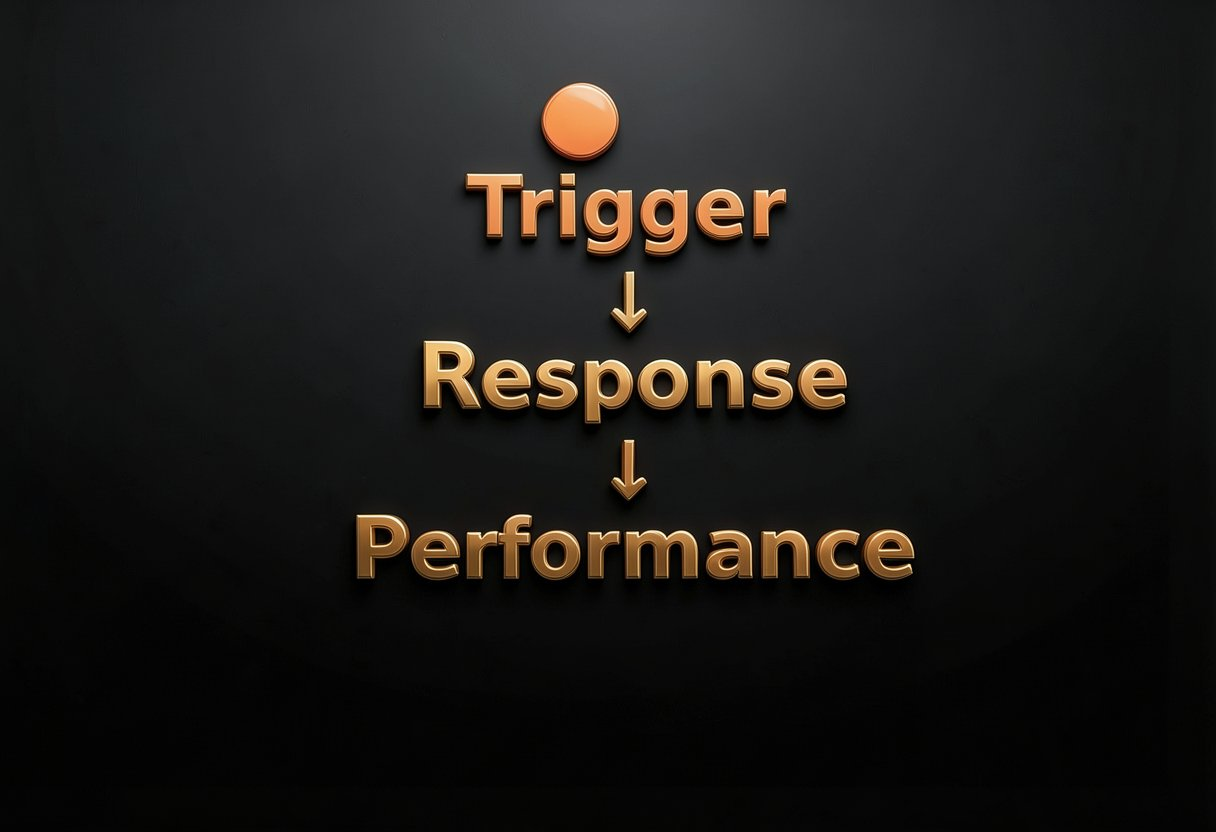
TRP — Trigger, Response, Performance.
Performance does not happen in isolation. It emerges through the interaction of:
- Stressors and situational demands (Trigger)
- Individual response patterns (Response)
- Observable performance outcomes (Performance)
The decisive question is not only what happens in one moment, but how the process unfolds over time.
Among the variables the proposed approach aims to examine are:
- Deviations in momentary states relative to the athlete's usual characteristics
- Cumulative exposure to triggers
- Longitudinal dynamics and trends
- Situational stakes, such as a final compared with training
- The quality and completeness of athletes' self-attributions
The research question is whether these observations might help identify relevant changes in performance-related processes before they become consequential in competition. They do not directly measure cortical or subcortical activity, nor can such activity be inferred from self-report alone.
Prediction Rather Than Intervention Alone
Many approaches focus on prevention in the sense of trying to stop an adverse event. Sixpack Mind AI also investigates the possibility of recognizing individual warning patterns earlier.
The aim is not to suppress emotions.
The aim is to understand potentially relevant risk dynamics.
The original concept proposed that persistent triggers, rising stakes and unstable trends might be associated with an increased probability of performance decline. Whether these variables genuinely predict decline—and under what conditions—remains an empirical research question.
Not a moral judgment.
Not a diagnosis.
A hypothesis that would require probabilistic testing.
In principle, this perspective might help athletes and their teams develop:
- Better-informed decisions about training and recovery
- More stable ways of responding to pressure
- Person-specific evidence for professional discussions
- More structured collaboration with sport psychologists
Reduced downtime, greater performance stability or financial benefits for clubs are possible outcomes to investigate, not demonstrated results.
A Startup with a Scientific Research Agenda
Sixpack Mind AI is not intended to remain a research project removed from practice. It is a market-oriented research and development initiative exploring how scientific knowledge might inform a specialized service for elite sport.
Biomechanical and physiological data are already routine in professional sport, while psychological performance processes are still often explained retrospectively.
Sixpack Mind AI aims to address this gap.
Not by replacing sport psychologists, but by supporting human expertise with more structured information.
The proposed system would provide a data-informed starting point for conversations among coaches, athletes and qualified psychological professionals. Its role would be to organize complexity, investigate recurring patterns and make potentially relevant developments visible for professional review. Its effectiveness has not yet been established.
Why This Matters Economically
A single failure in a competition that cannot be repeated can have significant financial consequences.
If some performance declines involve changing psychological and physiological dynamics, the research challenge is clear:
Can these dynamics be described and modeled responsibly?
Sixpack Mind AI is investigating that possibility with the ambition of making the approach scientifically defensible and practically relevant. Commercial value should be evaluated, not assumed.
An Invitation to Dialogue
Connecting neuropsychology, longitudinal analysis of emotional experience and probabilistic modeling may open new perspectives in elite sport.
As a startup, we deliberately work at the intersection of research and practical application.
Anyone interested in collaboration, pilot projects or professional exchange is welcome to contact us.
A decline in performance is not automatically a failure of character. It may involve complex system dynamics. Whether those dynamics can be modeled usefully for an individual athlete is precisely what needs to be investigated.
Explore the research discussion on prediction and its limits.